HOW WE THINK
Good engineering calls for technical rigour, creativity and collaboration, with attention to the particular needs of each project and the people it serves.
Good engineering demands both intellect and care.
Intellect brings the knowledge, curiosity and judgement to develop the right solution. Care ensures that these capabilities are exercised with integrity, responsibility and consideration for the people, resources and environments affected by our decisions.
At Ohr, we believe the two are inseparable. Together, they shape how we approach each project and the outcomes we seek to achieve.
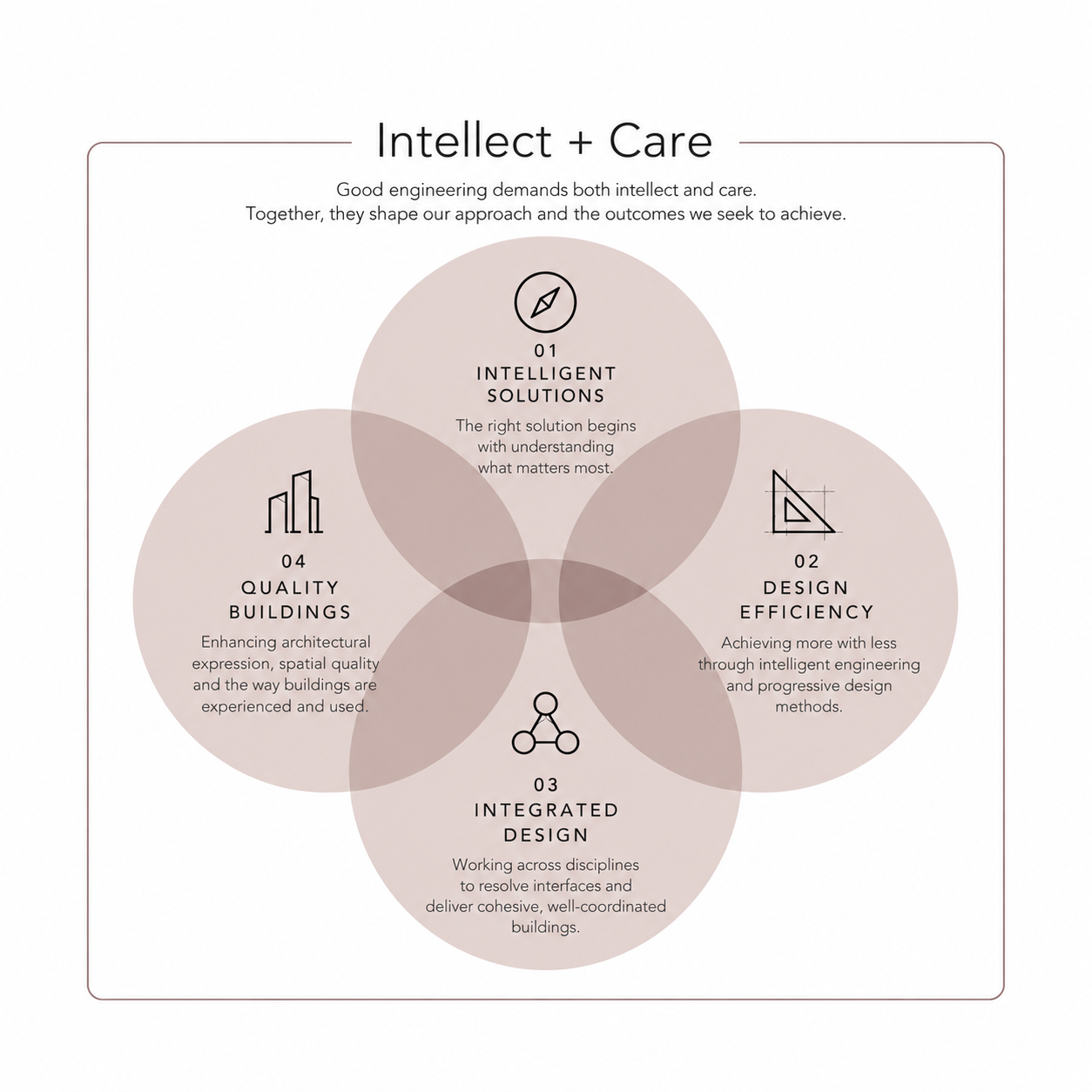
The right solution begins with understanding what matters most.
Every project presents a different set of challenges, opportunities and priorities.
We look beyond conventional responses, questioning assumptions and exploring alternatives to find solutions that address the particular demands of each project. This requires an understanding not only of structural behaviour, but also of architectural intent, site constraints, construction methodology, cost and long-term performance.
Innovation is not measured by complexity, but by the value it brings. Our aim is to arrive at the most appropriate solution — one that responds intelligently to the project's objectives and delivers value where it matters.
Achieving more with less through intelligent engineering and progressive design methods.
Efficient structures are the result of informed decisions made throughout the design process.
From the choice of structural system to the arrangement of elements, material selection and construction methodology, every decision presents an opportunity to improve performance and make better use of resources.
We consider how a structure works as a whole, seeking simplicity in load paths, efficiency in structural form and economy in material use. This is not simply an exercise in reducing quantities or costs, but in eliminating what is unnecessary while preserving what is essential.
Equally important is how we approach the design process itself. We continually explore new methods and technologies, from advanced analytical techniques to computational design, scripting and parametric modelling. These approaches allow us to investigate more possibilities, interrogate complex structural behaviour and refine solutions with greater precision.
Technology does not replace engineering judgement. Used intelligently, it extends our capabilities, allowing us to challenge conventional approaches and make more informed design decisions.
Working across disciplines to resolve interfaces and deliver cohesive, well-coordinated buildings.
A building is more than the sum of its individual systems. Its success depends on how effectively architecture, structure, building services, infrastructure and construction come together.
Structural decisions influence the work of other disciplines, just as their requirements shape the engineering response. Understanding these relationships early creates opportunities for better solutions and avoids unnecessary compromises later.
We work across disciplinary boundaries, bringing engineering insight into the wider design process and resolving interfaces through open dialogue and coordinated decision-making.
Enhancing architectural expression, spatial quality and the way buildings are experienced and used.
Good structural engineering contributes to more than the strength and stability of a building. It influences its appearance, proportions, spatial quality and the way people experience and use it.
The position of a column, the depth of a beam or the choice of structural system can determine the openness of a space, the flexibility of a layout and the clarity of an architectural form.
We consider these consequences as integral to structural design, developing solutions that support architectural intent while making effective use of the space available. Where appropriate, the structure itself can become an expression of the architecture.