
RESOURCES / Ohr
Too conservative?
A no is easy to question. How often do we ask what it cost to make the yes so easy?
This is the first in What would the engineer say?, a Pink Musings series on engineering judgement.
Pink Musing 007 · 12 November 2026
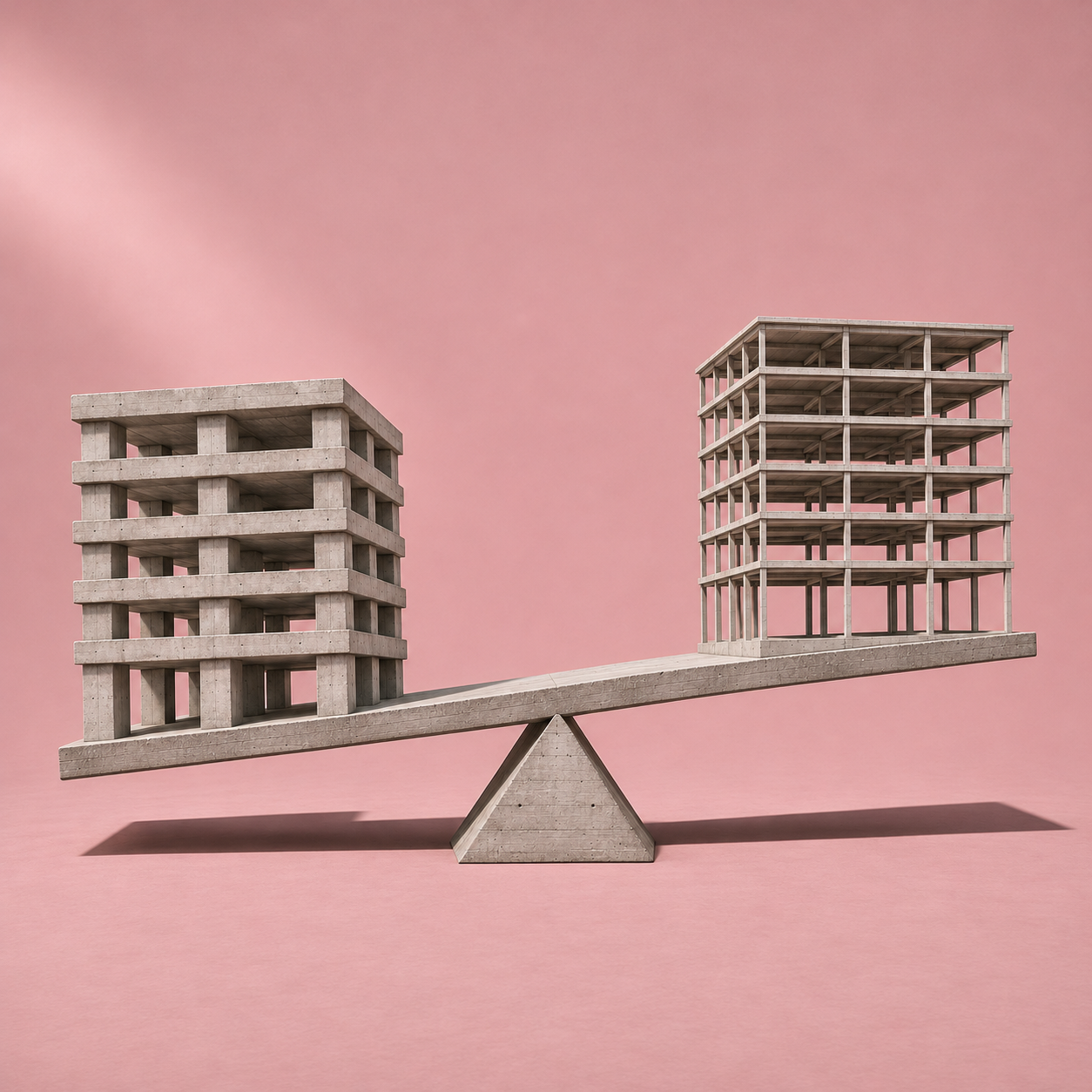
When one engineer says something cannot be done and another says it can, the first is often deemed to be too conservative. The second is seen as more practical. Is that necessarily so?
It is quite easy to say yes if there is more concrete and steel in the structure than the building needs. But who paid for it? The same client who wants an economical building. A no is easy to question. How often do we ask what it cost to make the yes so easy?
Designing efficiently means working out where the material is needed and how much is needed there. It takes more skill, time and effort than making everything a little bigger. That work has a cost, which shows up in the engineering fee. The extra concrete and steel show up in the construction cost. When comparing fees, how often do we consider what each design might cost to build?
There are good reasons to allow extra capacity where it serves a purpose. If a client wants the option of adding another floor one day, there is something to weigh up against the cost. But if extra material goes in just in case, or because the fee leaves too little time to refine the design, the client may end up paying for materials the building never needed.
How often do we ask what it cost to make the yes so easy?
There is another way to say yes. Agree to something without establishing that it works. “It’s common practice” is sometimes the explanation. Common practice where, and under what conditions? If an applicable code requirement is disregarded, or a check is skipped because the answer is assumed to be obvious, what exactly is known about the risk being taken? An engineer who insists on finding out may be called strict. Is that the same thing as being conservative?
Is it enough, then, to have an engineer say yes and put a stamp on the drawings? What gives that stamp its value is the engineering behind it. If the risk has yet to be properly assessed, the people who build, use and occupy the building may bear the consequences. And those consequences can be measured in more than money.
A no can be too conservative. An engineer may be relying on an assumption that deserves to be questioned. So ask what governs the answer. But ask the same question of the engineer who says yes. What makes it possible? How much does it cost? And what has been checked?
Pink Musings are editorials on our encounters within the Malaysian built environment and as a contribution towards upholding it.